
Cornering a Nuclear Power
NATO has lost its mind

Just came across this Xweet:
@Glenn_Diesen
NATO’s objective of bringing the war to Russia is advancing, as evidenced by today’s attack on Wildberries in Moscow. This can only go on for so long before Russia brings the war to NATO territory. Lunacy.
In an interview with Diesen, Jack Matlock, former US Ambassador to the Soviet Union appointed by the Reagan administration, summed the problem up:
We have a generation of leaders who did not experience the Cold War and seem not to have understood the lessons that we should have learned at that time.
The full interview begins with Matlock explaining why the current Russia–Ukraine conflict should be understood as the mirror image of the U.S.–Cuban missile crisis.
The lunacy mentioned by Diesen should indeed be undeniable, although obviously it isn’t. Being on a complaining-about-madness streak, it reminded me of something I have referred to, albeit only in part, numerous times, an excerpt from a book by Daniel Ellsberg.
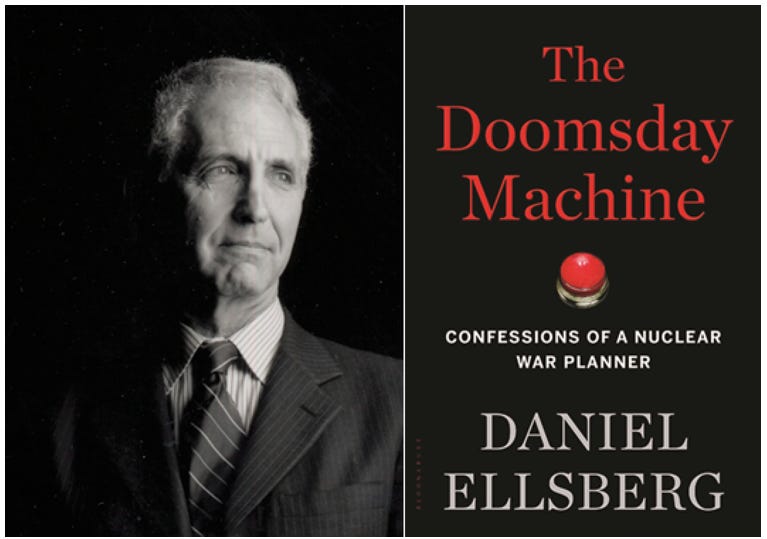
Ellsberg describes a meeting that took place in mid-December 1960, roughly a month before Kennedy was inaugurated. The timing is important because it would make Kennedy either a liar—if he had been told about the Single Integrated Operational Plan (SIOP), explained in more detail below—or a fool misled by his own cabinet. In this context, it is worth recalling that Kennedy ran his presidential campaign on the fictitious “missile gap”.
This is what Kennedy said on June 10, 1963 at American University. He began with wise words:
While defending our own vital interests, nuclear powers must avert those confrontations which bring an adversary to a choice of either a humiliating retreat or a nuclear war. To adopt that kind of course in the nuclear age would be evidence only of the bankruptcy of our policy or of a collective death wish for the world.
The current NATO policy is to do precisely what Kennedy warned against. Yet Kennedy then went on to say something that, in light of what we now know, was profoundly deceptive:
To secure these ends, America’s weapons are non-provocative, carefully controlled designed to deter and capable of selective use. Our military forces are committed to peace and disciplined in self-restraint.
To put that statement in perspective, consider the exchange below. It took place at a briefing for the Masters of War at which General Powers — “Headmaster of War”, one might say, as Commander of the Strategic Air Command at the time—made the following remarks.
From Doomsday Machine
The following is a verbatim excerpt from Ellsberg’s book. For clarity, I have added a few brief comments in square brackets.
Each time the briefer described an attack wave the ballet of the ladder masters would be re-enacted. They would untie another pair of red ribbons, a plastic roll would come whooshing down and Moscow would be even further obliterated beneath the little marks on those layers of plastic sheets. There were little marks in other places, too, but somebody noted that a third of Soviet industrial-military strength was concentrated in the greater Moscow area, hence the concentration of bombs dropped on that region. I recall that the plan called for a total of forty megatons-megatons-on Moscow, about four thousand times more than the bomb over Hiroshima and perhaps twenty to thirty times more than all the non-nuclear bombs dropped by the Allies in both theaters during more than four years of WWII…
At the point in the briefing where some bombers were described flying northeast from the Mediterranean on their way to Moscow, General Power waved at the speaker, saying: “Just a minute. Just a minute.” He then turned in his front row chair to stare into the obscurity of uniforms and dusk stretching behind me and said, “I just hope none of you have any relatives in Albania, because they have a radar station there that is right on our flight path, and we take it out.” With that, to which the response was utter silence, Power turned to the speaker and with another wave of the hand, told him to “Go ahead.”A subsequent chart shown by the briefer displayed deaths on the vertical axis and time in hours, extending out to weeks, along the horizontal axis. He announced that there were about 175 million people in the USSR. This chart depicted the deaths from fallout alone—not from the direct effects of blast or radiation from a bomb going off, just from fallout subsequent to the attacks when radioactive dust propelled to high altitudes by the initial blast begins to fall back to earth. The curve of deaths, rising as time went by, leveled off at about 100 million, showing that more than half the population of the Soviet Union would be killed from radioactive fallout alone… The briefing was soon concluded, to be followed by an identical one covering the attack on China given by a different speaker. Eventually, he too arrived at a chart showing deaths from fallout alone. “There are about 600 million Chinese in China,” he said. His chart went up to half that number, 300 million, on the vertical axis. It showed that deaths from fallout as time passed after the attack leveled out at that number, 300 million, half the population of China.
A voice out of the gloom from somewhere behind me interrupted, saying, “May I ask a question?” General Power [served as commander in chief of the Strategic Air Command] turned again in his front-row seat, stared into the darkness and said, “Yeah, what is it?” in a tone not likely to encourage the timid. “What if this isn’t China’s war?” the voice asked. “What if this is just a war with the Soviets? Can you change the plan?”
“Well, yeah,” said General Power resignedly, “we can, but I hope nobody thinks of it, because it would really screw up the plan.”Rubel [a business executive in the early post-World War II years of the war electronics industry] comments:
That exchange did it. Already oppressed by the briefings up to that point, I shrank within, horrified. I thought of the Wannsee Conference in January 1942, when an assemblage of German bureaucrats swiftly agreed on a program to exterminate every last Jew they could find anywhere in Europe, using methods of mass extermination more technologically efficient than the vans filled with exhaust gases, the mass shootings, or incineration in barns and synagogues used until then. I felt as if I were witnessing a comparable descent into the deep heart of darkness, a twilight underworld governed by disciplined, meticulous and energetically mindless groupthink aimed at wiping out half the people living on nearly one third of the earth’s surface. Those feelings have not entirely abated, even though more than forty years have passed since that dark moment.
The next morning, as Rubel relates, Secretary of Defense Gates [Gates was Secretary of War under Eisenhower] called a meeting “to discuss the proceedings of the previous evening. The Chiefs were there, I was there, and the Secretaries of the Army, Navy and Air Force joined the group.” Starting with the chairman of the JCS [Joint Chiefs of Staff], General Lyman Lemnitzer, each of these discussants said much the same thing: “The men had done a very fine job, a very difficult job, and that they should be commended for their work.”
Gates, thank Heaven, never turned to me. I had no idea what I would say if he did. I should have, but fear I would not have had the courage to say that this was the most barbaric, unthinkable, crazy so-called “plan” I had ever heard and could never have imagined.
One person, alone, at the second session raised objections. It was the commandant of the Marine Corps, David M. Shoup, who had earned the Congressional Medal of Honor for commanding from the beach the Marines who landed at Tarawa. Five years before this briefing I had heard him address my graduating class in the Infantry Basic School in the Marine Corps at Quantico. (From 1961 to the end of the war, he opposed vigorously our intervention in Vietnam.)
“All I can say is,” [Shoup] said in a level voice, “any plan [the Single Integrated Operational Plan (SIOP)] that murders three hundred million Chinese when it might not even be their war is not a good plan. That is not the American way.”
It was, however, the American plan. Though President Eisenhower was distressed when his science advisor George Kistiakowsky reported to him the tremendous amount of “overkill” in the plan, Eisenhower endorsed the plan and passed it on without any modification to John F. Kennedy a month later. It was my passion to change it.
“That is not the American way.” Food for thought…
ost of the politicdians on theplanet have lost thier minds,